





































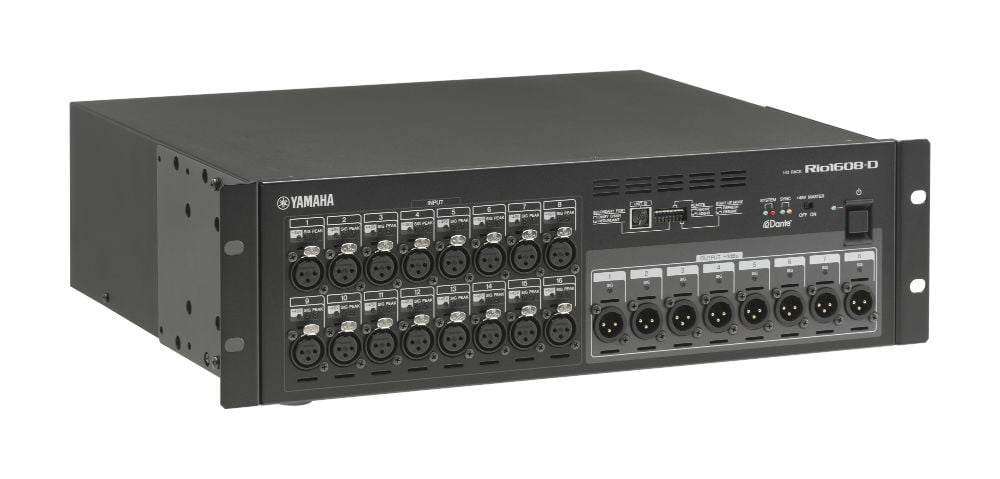
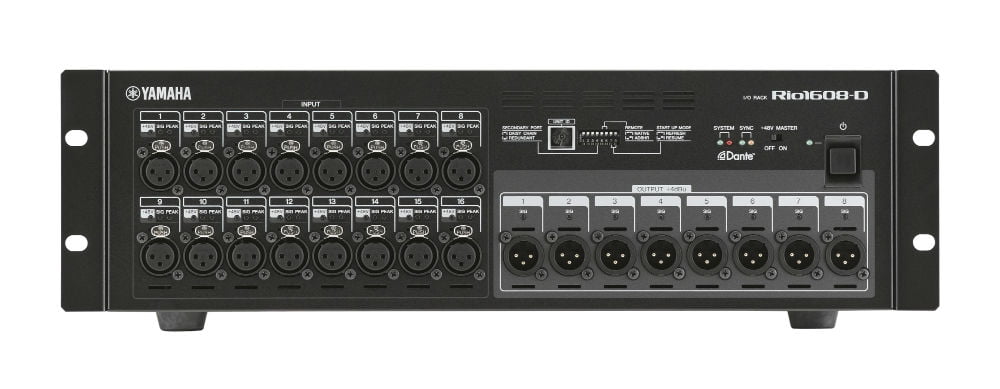
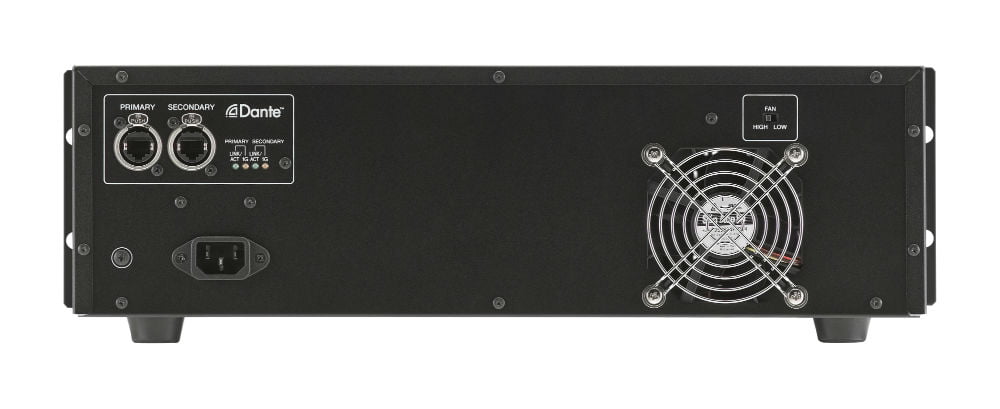
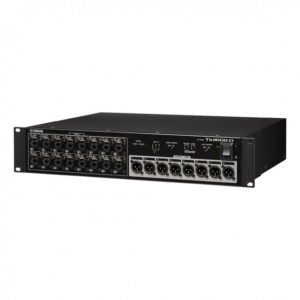
I/O Rack – stagebox for the CL series desks
The 3U size
16 ins, 8 outs,
4 AES/EBU outputs

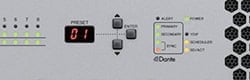
Network capabilities are rapidly becoming fundamental and indispensable in today’s fast-paced world of digital live sound. CL series consoles feature separate console and I/O rack components that communicate via the Dante™ network audio protocol, allowing fast, efficient design and deployment of capable systems from the most basic to the dazzlingly complex. The ability to add Lake® processing via expansion slots also adds to the system’s versatility and adaptability to the widest range of mixing needs.
Dante for Fast, Flexible Networking
The complexity and variety of today’s live sound systems makes fast, adaptable configuration and setup capability vital. Of course the highest level of sonic performance must be maintained at the same time. CL series consoles use the Dante network protocol developed by Audinate to allow flexible connection to multiple I/O rack units configured and located according to the needs of the application, while at the same time providing redundancy for superior reliability.
Up to Eight I/O Rack Units
Dante directly supports star network configurations, so up to eight I/O rack units can be connected to any single CL series console and conveniently located wherever they are needed most. A few simple DIP switch settings are all that is required to change to daisy-chain networking as required.
Simple Setup
The ability to set up even complex systems quickly and easily is another benefit of Dante networking. In most cases devices on the network are recognized and set up automatically. And since patching operations that usually require a separate computer can be carried out directly from the CL console, changes to the initial setup are painless as well.
Redundancy for Reliability
Dante also makes it easy to maximize system reliability. Star networks allow the use of redundant primary and secondary lines for each device, for the utmost reliability in critical applications. With this type of setup a malfunction in a cable or other network component won’t bring the whole system down. The show will go on.
Full Integration of FOH and Monitor Control
Multiple CL series consoles can share control of the same I/O rack unit, allowing unprecedented system flexibility and efficient use of system resources. A new Gain Compensation function adds the ability to combine FOH and monitor control via a single network, for comprehensive digital live sound integration.
I/O Rack Unit Sharing with Gain Compensation
One obvious drawback of connecting multiple consoles to a single I/O rack unit is that gain adjustments made from one console can cause unexpected gain changes at the other consoles. The Gain Compensation function implemented in the CL consoles ensures that when the analog gain stage is adjusted from one of the consoles, corresponding compensation is automatically applied at the digital stage so that the level sent from the I/O rack unit to the connected CL consoles remains constant.
| General specifications | Rio3224-D | Rio1608-D | |
|---|---|---|---|
| Sampling frequency rate | Internal | 44.1kHz, 48kHz, 88.2kHz, 96kHz | 44.1kHz, 48kHz, 88.2kHz, 96kHz |
| External | 44.1kHz: 4.1667%, 0.1%, -0.1%, -4.0% (±200ppm) / 48kHz: 4.1667%, 0.1%, -0.1%, -4.0% (±200ppm) / 88.2kHz: 4.1667%, 0.1%, -0.1%, -4.0% (±200ppm) / 96kHz: 4.1667%, 0.1%, -0.1%, -4.0% | 44.1kHz: 4.1667%, 0.1%, -0.1%, -4.0% (±200ppm) / 48kHz: 4.1667%, 0.1%, -0.1%, -4.0% (±200ppm) / 88.2kHz: 4.1667%, 0.1%, -0.1%, -4.0% (±200ppm) / 96kHz: 4.1667%, 0.1%, -0.1%, -4.0% | |
| Signal delay | Less than 3ms INPUT to OUTPUT, connect with CL5 using Dante, Dante Receive Latency set to 0.25ms (one way), Fs=48kHz | Less than 3ms INPUT to OUTPUT, connect with CL5 using Dante, Dante Receive Latency set to 0.25ms (one way), Fs=48kHz | |
| Total harmonic distortion | Less than 0.05% 20Hz-20kHz@ 4dBu into 600Ω, Fs=44.1kHz, 48kHz / Less than 0.05% 20Hz-40kHz@ 4dBu into 600Ω, Fs=88.2kHz, 96kHz INPUT to OUTPUT, Input Gain = Min. | Less than 0.05% 20Hz-20kHz@ 4dBu into 600Ω, Fs=44.1kHz, 48kHz / Less than 0.05% 20Hz-40kHz@ 4dBu into 600Ω, Fs=88.2kHz, 96kHz INPUT to OUTPUT, Input Gain = Min. | |
| Frequency response | 0.5, -1.5dB 20Hz-20kHz, refer to 4dBu output @1kHz, INPUT to OUTPUT, Fs=44.1kHz, 48kHz / 0.5, -1.5dB 20Hz-40kHz, refer to 4dBu output @1kHz, INPUT to OUTPUT, Fs=88.2kHz, 96kHz | 0.5, -1.5dB 20Hz-20kHz, refer to 4dBu output @1kHz, INPUT to OUTPUT, Fs=44.1kHz, 48kHz / 0.5, -1.5dB 20Hz-40kHz, refer to 4dBu output @1kHz, INPUT to OUTPUT, Fs=88.2kHz, 96kHz | |
| Dynamic range | 108dB typ., INPUT to OUTPUT, Input Gain = Min | 108dB typ., INPUT to OUTPUT, Input Gain = Min | |
| Crosstalk | -100dB, adjacent INPUT/OUTPUT channels, Input Gain = Min. | -100dB, adjacent INPUT/OUTPUT channels, Input Gain = Min. | |
| Power requirements | US/Canada: 120V 60Hz, Japan: 100V 50/60Hz, China: 110-240V 50/60Hz, Korea: 220V 60Hz, Other: 110-240V 50/60Hz | US/Canada: 120V 60Hz, Japan: 100V 50/60Hz, China: 110-240V 50/60Hz, Korea: 220V 60Hz, Other: 110-240V 50/60Hz | |
| Power consumption | 120W | 70W | |
| Dimensions | W | 480mm (18 7/8in) | 480mm (18 7/8in) |
| H | 232mm (9 1/4in) | 144mm (5 3/4in) | |
| D | 361.5mm (14 1/4in) | 361.5mm (14 1/4in) | |
| Net weight | 12.4kg (27.3lb) | 8.8kg (19.4lb) | |
| Others | Temperature Range: Operating temperature range: 0 – 40℃, Storage temperature range: -20 – 60℃ | Temperature Range: Operating temperature range: 0 – 40℃, Storage temperature range: -20 – 60℃ | |
Analog input characteristics
| Input Terminals | GAIN | Actual Load Impedance | For Use With Nominal | Input Level | Connector | |
|---|---|---|---|---|---|---|
| Nominal | Max. before clip | |||||
| INPUT 1-16 | 66dB | 10kΩ | 50-600Ω Mics & 600Ω Lines | -62dBu (0.616mV) | -42dBu (6.16mV) | XLR-3-31 type (Balanced)*1 |
| 18dB | -14dBu (155mV) | 6dBu (1.55V) | ||||
| 17dB | 3kΩ | -13dBu (174mV) | 7dBu (1.74V) | |||
| -6dB | 10dBu (2.45V) | 30dBu (24.5V) | ||||
| INPUT 17-32*5 | 66dB | 10kΩ | 50-600Ω Mics & 600Ω Lines | -62dBu (0.616mV) | -42dBu (6.16mV) | XLR-3-31 type (Balanced)*1 |
| 18dB | -14dBu (155mV) | 6dBu (1.55V) | ||||
| 17dB | 3kΩ | -13dBu (174mV) | 7dBu (1.74V) | |||
| -6dB | 10dBu (2.45V) | 30dBu (24.5V) | ||||
*1. XLR-3-31 type connectors are balanced.(1=GND, 2=HOT, 3=COLD)
*2. In these specifications, 0dBu = 0.775 Vrms.
*3. All input AD converters are 24bit linear, 128times oversampling.
*4. 48V DC ( phantom power ) is supplied to INPUT XLR type connectors via each individual software controlled switch. *5. Rio3224-D only
Analog output characteristics
| Output Terminals | Actual Source Impedance | For Use With Nominal | Max.Output Level Select SW*4 | Output Level | Connector | |
|---|---|---|---|---|---|---|
| Nominal | Max. before clip | |||||
| OUTPUT 1-8 | 75Ω | 600Ω Lines | 24dB (default) | 4dBu (1.23 V) | 24dBu (12.3V) | XLR-3-32 type (Balanced)*1 |
| 18dB | -2dBu (616mV) | 18dBu (6.16V) | ||||
| OUTPUT 9-16*5 | 75Ω | 600Ω Lines | 24dB (default) | 4dBu (1.23 V) | 24dBu (12.3V) | XLR-3-32 type (Balanced)*1 |
| 18dB | -2dBu (616mV) | 18dBu (6.16V) | ||||
*1. XLR-3-32 type connectors are balanced.( 1=GND, 2=HOT, 3=COLD )
*2. In these specifications, 0dBu = 0.775 Vrms.
*3. All output DA converters are 24bit, 128times oversampling.
*4. There are switches inside the body to preset the maximum output level. *5. Rio3224-D only
Brand
Yamaha
You must be logged in to post a review.
Related products
Request Price:
£379.00 Inc VAT
Request Price:
Request Price:
Request Price:
Reviews
There are no reviews yet.